Teeth Falling Out Dreams: A Cross-Cultural Analysis
Calvin Hall spent years cataloguing thousands of dream reports across demographics, and one image showed up with striking regularity: teeth falling out. His 1966 content analysis of dream samples, one of the most systematic studies of its kind, confirmed what anecdote had long suggested — tooth loss is among the most universally reported dream images across cultures. Nearly every tradition has a version of it. A specific name for it. An interpretation framework built around it.
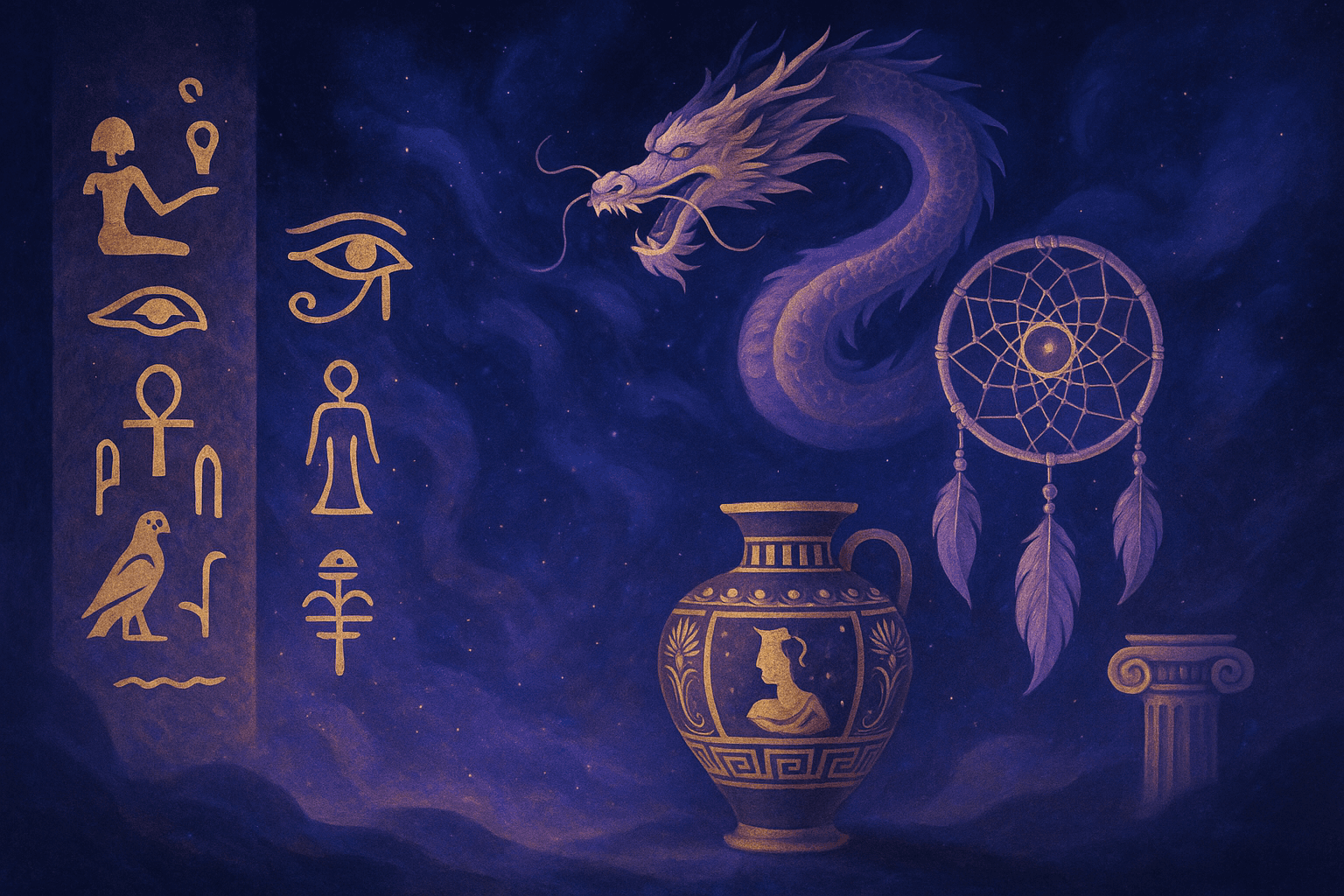
But those frameworks point in completely different directions. Western psychology treats teeth dreams as anxiety signals. Islamic tradition reads each individual tooth as a proxy for a specific family member. Ancient Egyptians tied tooth imagery to the aging of the soul. The same image, processed through different cultural lenses, produces meanings that don't overlap at all. That's genuinely striking. A dream image this universally shared should, by some logic, produce convergent interpretations. It doesn't. That divergence is what makes this worth taking seriously.
The Western Psychological Reading
Freud's interpretation of tooth dreams is the one most people have heard of, and it has not aged well. He connected tooth loss to masturbation anxiety — a reading that was largely abandoned by his own successors and is now considered a historical curiosity more than a clinical insight.
Carl Jung's approach holds up considerably better. Jung read teeth as symbols of the Persona — the social mask a person constructs for public life. Losing teeth in a dream, especially in front of others, mapped onto fear of humiliation: the collapse of the image one carefully projects. It connects to concerns about competence, status, and what other people see when they look at you. Losing teeth publicly in a dream is the Persona cracking.
Contemporary researchers have moved toward more empirical methods. Kelly Bulkeley, one of the more rigorous modern dream researchers, finds tooth loss dreams most common during periods of dental anxiety (the most literal reading), job insecurity, communication difficulties, and major life transitions. A 2018 meta-analysis published in Frontiers in Psychology by Sabstractly Lev-Ari and colleagues found a notable correlation between teeth dreams and dental irritation during sleep — suggesting that physical sensations in the mouth can seed the dream imagery. That's a plausible mechanism. It doesn't explain, though, why teeth dreams so consistently carry emotional weight far beyond their physical trigger, or why the imagery feels so symbolically loaded to people who wake from them.
Ibn Sirin and the Islamic Framework
The 8th-century scholar Muhammad ibn Sirin wrote what remains the most influential Islamic text on dream interpretation, Tafsir al-Ahlam. His treatment of teeth is one of the most granular sections of the entire work, and it operates on a logic completely unlike the Western psychological approach.
Ibn Sirin mapped each tooth to a specific family member. The system works roughly as follows:
- Upper right incisors correspond to the dreamer's father or eldest male relative
- Upper left incisors correspond to the dreamer's mother or eldest female relative
- Canines correspond to the dreamer's siblings or close male relatives on the father's side
- Back molars correspond to the dreamer's children or younger generations
Losing a tooth in a dream, within this framework, is not primarily a statement about the dreamer's psychological state. It's a signal about that family member specifically — something affecting them, whether difficulty, illness, or loss. The manner of loss carries its own meaning: a tooth that falls out cleanly and without pain may indicate a natural life transition for that person, something that completes its course. A tooth that is yanked out or crumbles violently reads as more alarming.
This system demands something most modern interpretation frameworks don't: that the dreamer know their family situation in detail, and apply that knowledge to decode the dream. It's relational interpretation, not introspective interpretation. You don't look inward; you look outward at your kin.
The Jungian Shadow Angle
Beyond the Persona reading mentioned above, Jung's framework includes a second angle on teeth dreams that's worth separating out. In Jungian symbolism, teeth function as power symbols in a fairly direct sense — they are the equipment for biting, tearing, asserting force. To lose teeth is to lose the capacity to assert oneself, to compete, to hold one's ground.
This connects to Jung's concept of the shadow — the repository of disowned qualities, including aggression and self-assertion. People who repress their capacity for conflict or self-assertion may encounter teeth imagery in their dreams with particular frequency. The loss of teeth in this reading signals not just anxiety but a specific kind of powerlessness: the inability to bite back.
Jung was careful to note that this isn't always pathological. Sometimes losing power in a dream is the psyche's way of pointing toward necessary psychological work — specifically, the work of releasing ego control and accepting limitation. The teeth fall out; the grip loosens. Whether that's a warning or an invitation depends heavily on the dreamer's actual life circumstances.
Chinese Traditional Interpretation
Zhou Gong's dream dictionary — attributed to the Duke of Zhou, a revered figure of the early Zhou dynasty, though the texts we have are compiled from much later periods — treats tooth loss with particular attention to family relationships. The framework has surface similarities to Ibn Sirin's, but the underlying logic differs.
In the Chinese traditional reading, tooth loss often signals disruption within the family unit. A tooth falling out can indicate that an elder family member is in difficulty, or that family relations are under strain. The family connection is structural: teeth are seen as extensions of the bone, and bone connects to ancestry. This isn't a metaphor in the modern sense; it's a cosmological claim about the body's relationship to lineage.
There's also a parallel folk tradition in China that reads tooth loss dreams more simply as inauspicious omens — bad luck incoming, without specifying a target. These two layers (the specific family-relational reading and the general ill-omen reading) coexist in practice, and which one a dreamer applies often depends on the vividness of the dream and whether a particular family member is already on their mind.
Timing adds another variable. Dreams occurring in the first months of the lunar year carry different weight than those occurring later; tooth loss dreams near the lunar new year are read with more urgency, as the new year period is considered especially sensitive for omens.
Biblical and Christian Interpretation
The Hebrew Bible does not address tooth loss dreams directly. Teeth appear in various contexts — the lex talionis principle, Proverbs' references to the righteous and wicked — but not as a specific dream symbol with an established interpretive tradition.
Christian dream interpretation, which developed later and drew from multiple sources including Greco-Roman oneirocriticism, tends to read tooth imagery through the lens of communication and spiritual authority. Teeth as the instruments of speech: to lose teeth in a dream may signal anxiety about speaking truthfully, or a loss of the ability to articulate something important. There's also a feeding dimension — teeth as the means of taking in nourishment, including spiritual nourishment.
Some streams of charismatic Christianity, particularly those that take dreams as direct spiritual communication, read tooth loss as a symbol of spiritual authority under threat. In this framework, teeth represent the believer's capacity for spiritual "bite" — effectiveness in prayer, boldness in proclamation. Losing them signals a felt loss of spiritual potency, and may be read as a call to prayer and renewed commitment.
Hindu Interpretation
Hindu dream interpretation draws from several ancient sources, with the Atharva Veda among the oldest texts to address dream symbolism. References to bodily omens including tooth imagery appear in Vedic literature, typically framed as signs requiring ritual response rather than purely psychological reflection.
Tooth loss in Hindu dream interpretation is generally classified as an inauspicious sign. The specific significance varies by which tooth is lost, which side of the mouth, and contextual details of the dream. As in the Islamic framework, there's a family-relational dimension: lost teeth can correspond to family members experiencing difficulty, though the mapping is less systematized than Ibn Sirin's.
What distinguishes the Hindu approach is the prescriptive response. The dream isn't merely interpreted; it's acted upon. Specific prayers, temple visits, or offerings may be recommended depending on the dream's particulars. The interpretation is embedded in a ritual framework that assumes dreams communicate something real about the waking world and that the appropriate response is action, not merely insight.
What Actually Causes Teeth Dreams?
The scientific angle here is more interesting than it first appears. Bruxism — teeth grinding during sleep — is significantly more common than most people realize, affecting an estimated 8–10% of adults and substantially higher percentages of people under stress. Bruxism creates real physical sensation in the jaw and teeth during sleep. That sensation needs to be incorporated into dream content somehow, and the dreaming brain may construct narratives around it: the teeth feel wrong, therefore the teeth are falling out.
The stress-bruxism-dream connection potentially runs in both directions. Stress increases bruxism. Bruxism may seed teeth imagery in dreams. Teeth dreams are correlated with periods of stress. The physical and the psychological mechanisms reinforce each other, which may explain why the correlation between teeth dreams and anxiety is so consistent across cultures even when the cultural interpretations of that anxiety differ so dramatically.
This doesn't resolve the deeper question of why teeth imagery carries such consistent emotional weight. But it does suggest that the experience of teeth falling out in a dream isn't purely symbolic — there may be a sensory substrate driving it.
Frequently Asked Questions
Why do I keep dreaming about my teeth falling out?
Recurring teeth dreams most commonly appear during periods of stress, major life transitions, or when something in your life feels insecure or unstable. If the dreams are very frequent, it's also worth considering whether you grind your teeth during sleep — bruxism creates physical sensations that can generate the imagery directly. Recurring dreams of any kind tend to indicate that the dreaming mind is processing something unresolved.
What does it mean when your teeth fall out in a dream according to different cultures?
It varies considerably. Western psychology connects teeth dreams to anxiety about appearance, status, or communication. Islamic tradition (following Ibn Sirin) reads each tooth as corresponding to a specific family member, so the dream is about that person rather than the dreamer. Chinese and Hindu traditions both emphasize family connections but embed the interpretation in broader cosmological frameworks. Biblical and charismatic Christian readings focus on speech and spiritual authority.
Does dreaming about teeth falling out mean someone will die?
This fear comes up often, and it's worth being direct: there is no evidence that dream content predicts real-world events. The association between tooth loss dreams and death or loss in some cultural frameworks (particularly the Islamic reading, where a lost tooth may signal a family member is in difficulty) reflects that tradition's interpretive framework, not a literal predictive claim. Dreams don't foretell the future in any scientifically established sense.
Are teeth falling out dreams more common in women?
Some survey data suggests women report teeth dreams at slightly higher rates than men, but the difference is modest. Teeth dreams appear across demographics in substantial numbers. The content of the anxiety embedded in teeth dreams may differ by gender — concerns about appearance and social perception versus concerns about power and competence — but the core imagery is broadly distributed.
What's worth sitting with, after looking at these six traditions, is that none of them are simply wrong. They're each asking a different question when they encounter the same image. Western psychology asks: what does this say about the dreamer's inner state? Ibn Sirin asks: which family member does this concern? Hindu tradition asks: what action is now called for? The image is the same. The interpretive question shapes everything that follows.
Explore the full teeth dream meaning in our dictionary — including complete Islamic, Jungian, Biblical, Hindu, and Chinese interpretations side by side.
References
- Calvin S. Hall, The Content Analysis of Dreams (1966, Appleton-Century-Crofts) — Google Scholar
- Muhammad ibn Sirin, Tafsir al-Ahlam — Ibn Sirin on Wikipedia
- Kelly Bulkeley, dream content research — Google Scholar
- Lev-Ari, S. & Lev-Ari, L. (2018), "Teeth dreams and dental irritation", Frontiers in Psychology — Google Scholar
- Carl G. Jung, Man and His Symbols (1964) — Wikipedia
- Duke of Zhou's dream dictionary — Wikipedia
- Atharva Veda (dream omen traditions) — Wikipedia
- "Bruxism" (teeth grinding during sleep) — Wikipedia