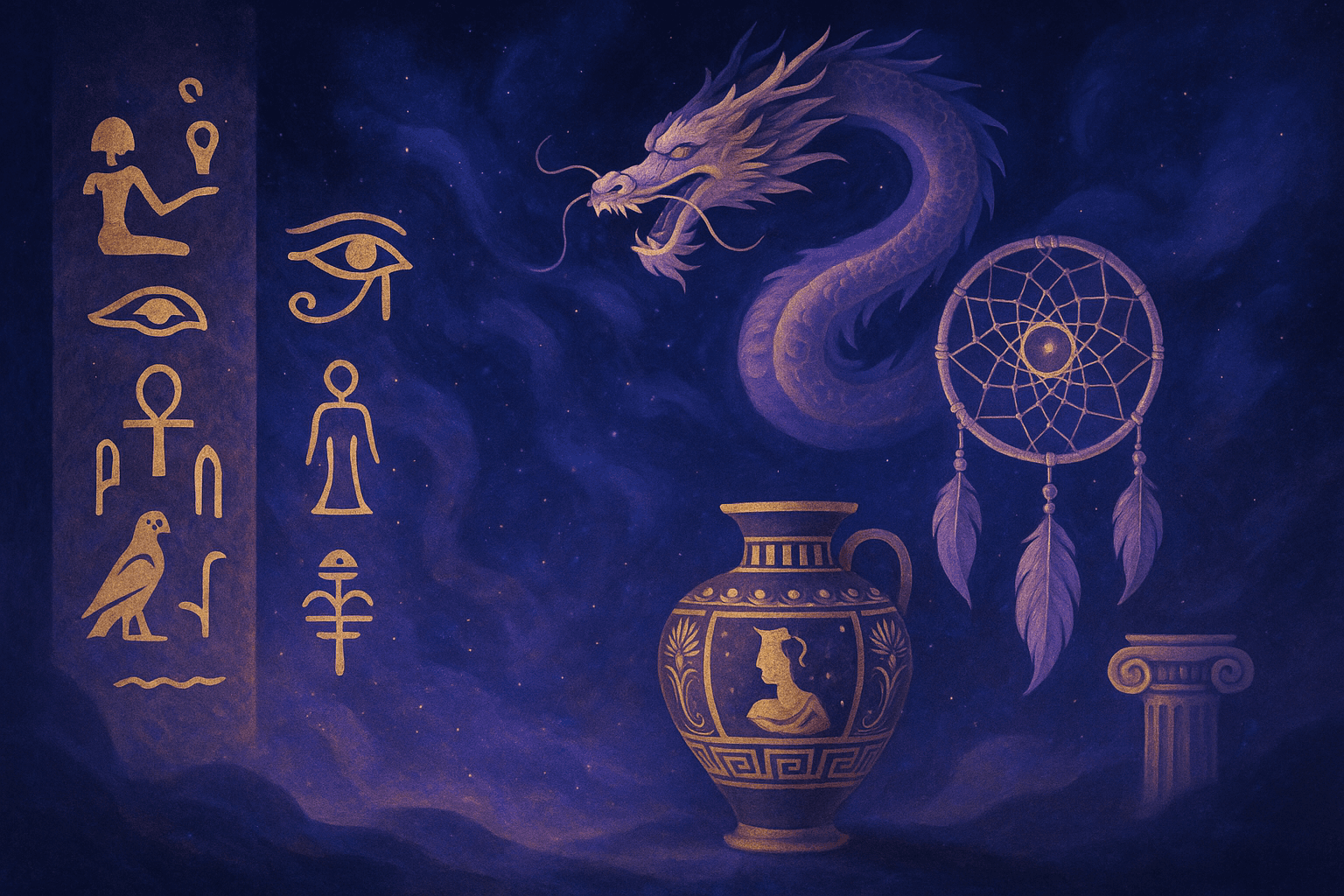
Death in Dreams Across 6 Traditions: Is It Ever Actually Bad?
If you woke up in the middle of the night from a death dream and you're scared — start here: across nearly every tradition that has thought carefully about dreams, dreaming of death almost never means that you or someone you love is going to die. Not in Islamic scholarship. Not in Jungian psychology. Not in Hindu or Chinese or Biblical interpretation. That's not wishful thinking; it's the actual consensus across thousands of years of recorded dream analysis.
This doesn't make death dreams trivial. They're among the most symbolically loaded dreams a person can have, and they tend to appear at significant moments in life for reasons that are worth understanding. But if the question is whether to panic, the answer from every tradition examined here is: no.
What does it mean, then? That depends on whose framework you're working in — and each of the six traditions below gives a genuinely different answer.
Why Death Appears in Dreams So Often
Death is one of the most common dream themes, which surprises people who assume it must be rare. It isn't. The reason has to do with what the sleeping mind is actually processing.
The brain doesn't neatly categorize "ending." When a relationship is falling apart, when a job is changing, when an identity you've held for years is becoming something new — the mind processes all of these as a kind of ending, and endings share psychological architecture with literal death. The emotional weight is similar. The sense of irreversibility is similar. The fear of what comes next is the same fear.
So death appears in dreams not because the unconscious mind is predicting literal events, but because it is the most available symbol for "something significant is ending or changing." The more accurately you can identify what that something is, the more useful the dream becomes.
Western and Freudian Interpretation
Freud's position, developed in The Interpretation of Dreams (1900), was that we are psychologically incapable of truly imagining our own death — and so when death appears in dreams, it is always symbolic displacement. He linked dreams of someone else dying to repressed hostility: to dream of a sibling or rival dying was, for Freud, often an expression of jealousy or competitive feeling that couldn't be acknowledged consciously.
Modern Western secular interpretation has largely set this aside. Contemporary therapists and dream analysts tend to read death dreams through a simpler lens: death signals transformation, ending, or anxiety about change. What specifically is dying in the dream matters enormously. A dream in which a childhood version of yourself dies means something quite different from one in which your boss dies or your house burns down.
The useful question Western psychological interpretation asks is: what does this dying figure or dying element represent to you? Not in the abstract — concretely, in your actual life right now. Death in a dream is often the mind's way of marking a transition that is already happening. It's acknowledging the ending before the conscious mind is ready to.
That acknowledgment can be uncomfortable. It can also be clarifying.
Islamic Interpretation: Ibn Sirin
The most systematic classical Islamic treatment of dream interpretation comes from Muhammad ibn Sirin (died 729 CE), whose Tafsir al-Ahlam remains the foundational reference in Islamic dream scholarship. His treatment of death in dreams is consistently non-literal and, often, surprisingly positive.
Dreaming of your own death: Ibn Sirin frequently interpreted this as the end of sin, hardship, or a period of difficulty. In some readings it signals repentance — the death of the sinful self. It can also mean the end of a bad phase practically: losing a job, leaving a bad relationship, moving out of a difficult situation.
Dreaming of a specific person dying: Ibn Sirin generally refused to read this as literal prediction. More commonly, he interpreted it as a signal that the dreamer's relationship with that person is changing, or that the dreamer has unprocessed emotion about them.
Dying and being resurrected in the same dream: This is considered a very positive sign — renewal of spiritual life, recovery from illness, or the return of prosperity after loss. The resurrection element is key; it reframes the death as passage rather than ending.
Being told you will die at a specific time: Ibn Sirin treated this category with more nuance. If the dream carries a calm, peaceful quality, he sometimes read it as a sign of spiritual readiness. If it feels frightening, he associated it with the nafs al-ammara — the lower self expressing fear rather than delivering prophecy.
Throughout his work, Ibn Sirin was careful to note that interpretation depends heavily on context: the dreamer's current life circumstances, the emotional quality of the dream, and the presence or absence of other symbols.
Jungian Interpretation
Carl Jung approached death in dreams as one of the most significant and — importantly — one of the most potentially positive symbols the unconscious could produce. His position was direct: death in dreams almost always signals psychological transformation, not literal death. The ego must sometimes "die" so that something new can emerge in the psyche.
Who or what dies in the dream shapes the interpretation considerably. If a shadow figure dies — a dark or threatening character — it may mean the dreamer is beginning to integrate something previously rejected or feared in themselves. If a wise or guiding figure dies, the dreamer may be losing access to inner guidance they still need, a warning to pay attention to that part of themselves.
Jung analyzed his own death dreams at length in Memories, Dreams, Reflections, reading them as markers of psychological development rather than physical omens. He described periods in his life when repeated death imagery in dreams corresponded to major internal reorganizations — the collapse of old frameworks and the emergence of new ones.
In analytical psychology, a death dream at a significant life transition is almost a cliché — it's that common. Midlife, the end of a relationship, leaving a career, becoming a parent: all of these tend to generate death imagery in dreams because the psyche is accurately registering that an old version of the self is ending.
Biblical Interpretation
The Biblical framework brings a theological lens that shapes everything: death is not the end but a passage. Paul's letter to the Romans makes the architecture explicit: "We were buried therefore with him by baptism into death, in order that, just as Christ was raised from the dead by the glory of the Father, we too might walk in newness of life" (Romans 6:4). Death, in this framework, is the necessary precondition for resurrection and new life.
Christian dream interpreters working in this tradition tend to read death in dreams as transformation — the ending of something that needs to end so that something better can begin. The question they ask is: what needs to die in my life so that I can move forward?
The Old Testament picture is more varied. Prophetic visions in the Hebrew Bible sometimes contain warnings about literal death, but these typically came to prophets in highly specific visionary experiences — not the kind of ordinary night dream most people have. For ordinary dreamers, the consistent pattern in both Testaments is that God uses dreams to communicate direction, warning, and comfort — not to deliver morbid predictions.
Death dreams in a Biblical interpretive context are therefore more often read as invitations to change than as foreboding. What is God asking me to release? What old way of being is no longer serving?
Hindu and Vedic Interpretation
Hindu tradition is perhaps the most philosophically prepared of all six frameworks for death dreams, because Hindu cosmology treats death as inherently cyclical. Death is not finality; it is transition within samsara, the cycle of rebirth and renewal. To dream of death is, in this context, to dream of change — significant change, but change nonetheless.
Dreaming of death is often interpreted in Hindu tradition as the completion of a karma cycle or a significant shift in the dreamer's spiritual development. The death of the ego — the dissolution of the small, individual self — carries obvious positive weight in traditions that see ego attachment as the root of suffering. Here the parallel to Jungian thought is real, though the frameworks arrived at it independently.
One area where Hindu interpretation adds caution: dreaming of the death of a deity or sacred figure. This is typically read as a negative sign requiring ritual attention — a specific category that stands apart from the general interpretation of death as transformation.
Chinese Interpretation: Zhou Gong
Zhou Gong's dream dictionary, the classical Chinese reference attributed to the Duke of Zhou, reads death dreams through a fortune-and-omen lens more than a psychological or spiritual one — and its conclusions will surprise most Western readers.
Dreaming of your own death is generally considered an auspicious sign in the Zhou Gong tradition. Death, in Chinese cosmology, represents transformation and renewal; to dream of dying is to dream of significant positive change approaching. This is not a marginal interpretation — it is the mainstream reading in classical Chinese dream analysis.
Dreaming of attending a funeral, similarly, is often read as a sign that good news is coming, particularly regarding financial or professional matters. Weeping at a funeral in a dream is sometimes interpreted as joy arriving.
The inversion of Western intuitions here is real and worth noting: it reflects a cosmological difference, not just an interpretive quirk. When death is genuinely understood as transition rather than terminus, the emotional register of a death dream shifts entirely.
When Death Dreams Might Warrant More Attention
This is worth being direct about: in a small number of cases, death dreams may deserve more careful consideration.
In some classical Islamic scholarship, highly specific death dreams are treated with more seriousness — particularly if they involve a clear setting, a specific named person, a calm (rather than frightening) quality, and unusual vividness that distinguishes them from ordinary dreams. Even within this framework, a single dream is never treated as proof of anything.
Across traditions, the markers that tend to prompt additional reflection (rather than dismissal) are these: recurring death dreams with increasing specificity over time; death dreams accompanied by intense dread with no sense of resolution or symbolic transformation; and dreams that feel qualitatively different from ordinary dreams in a way the dreamer finds difficult to articulate.
None of these is a reason to panic. They are reasons to pay closer attention — to track the dreams, to consider what transitions or endings are active in your life, and perhaps to talk to someone you trust.
Frequently Asked Questions
Does dreaming of death mean someone will die?
In virtually every tradition that has studied dream interpretation seriously, no. Ibn Sirin, Jung, Biblical interpreters, Hindu scholars, and Chinese dream analysts all converge on the same answer: death in dreams is almost always symbolic. It represents change, ending, transformation, or transition — not literal prediction. The rare exceptions involve highly specific, recurring dreams with unusual qualities that distinguish them from ordinary dreaming.
What does it mean to dream of your own death?
It depends on which tradition you're drawing from, but the most consistent answer across all six is: something in your life is ending or transforming, and the dream is marking that transition. Ibn Sirin often read it as the end of a difficult period. Jung read it as the ego giving way to something new. Chinese tradition reads it as a positive omen. Almost no tradition reads it as a literal prediction.
What does it mean to dream of a parent or loved one dying?
This is one of the most common death dreams and one of the most frightening. In Jungian terms, a parent in a dream often represents an internalized authority or a way of seeing yourself — so a parent's death may signal that that inner authority is shifting. In Ibn Sirin's framework, dreaming of a close person's death more often reflects the dreamer's feelings about that relationship than it predicts anything about the person. In Western psychology, these dreams are often most frequent during periods of growing independence or changing relationship dynamics.
Why do I keep having death dreams?
Recurring death dreams usually signal a significant and ongoing transition the dreamer hasn't fully processed. Something is ending — or needs to end — and the unconscious mind keeps returning to it because the conscious mind hasn't fully reckoned with it. The question worth sitting with is: what in my life is changing that I'm having difficulty accepting? The dream is rarely about literal death. It's almost always about that.
Explore the full death dream meaning across all six traditions in our dictionary — with complete interpretations from Ibn Sirin, Jung, Biblical sources, Hindu texts, Chinese tradition, and modern Western analysis.
References
- Muhammad ibn Sirin (654–728 CE), Tafsir al-Ahlam — Ibn Sirin on Wikipedia
- Sigmund Freud, The Interpretation of Dreams (1899) — Archive.org
- Carl G. Jung, Memories, Dreams, Reflections (1962) — Carl Jung on Wikipedia
- The Holy Bible — Romans 6:4 — Bible Gateway
- Duke of Zhou's dream dictionary — Wikipedia
- Swami Sivananda on Hindu dream symbolism — Wikipedia
- "Samsara" (Hindu cycle of rebirth) — Wikipedia
- Kelly Bulkeley, Dreaming in the World's Religions (2008) — Google Scholar