Flying Dreams: What Five Major Traditions Say About Them

Flying is one of the few dream experiences that people describe wanting to have again. Most people wake from a flying dream and feel something close to reluctance — the sensation of rising, of moving freely above everything familiar, of looking down at the world from a remove that felt genuinely peaceful. It's vivid in a way that other dreams often aren't, and it tends to stay with you into the morning.
The question of what it means is worth taking seriously. Flying is among the most frequently reported dream types across cultures, historical periods, and demographics. It shows up in ancient texts and in modern sleep studies. It appears in traditions that have nothing else in common. That consistency suggests something worth paying attention to, whether you approach dreams psychologically, spiritually, or simply with curiosity about your own mind.
This article looks at five major interpretive frameworks — Islamic, Freudian-to-modern Western, Jungian, Hindu and shamanic, and Chinese — and at what they actually agree on, which is more than you might expect.
Why We Fly: The Science, Briefly
Sleep research offers a partial explanation for the flying sensation itself. During REM sleep, the vestibular system — the inner-ear system responsible for tracking your body's position and movement in space — becomes partially active. Without the usual external reference points of waking life (a floor underfoot, a fixed horizon), the brain receives vestibular signals that it has to make sense of without grounding data.
One plausible result: the brain constructs a narrative around the sensation of movement that has no physical cause, and that narrative is often flight. Psychologist Stanley Krippner, who spent decades researching dream states, noted that flying dreams correlate with REM sleep stages and with heightened vestibular sensitivity in certain individuals.
This accounts for the physical experience. It doesn't account for the meaning — for why flying feels like freedom rather than falling, or why different emotional contexts produce such different versions of the same dream. For that, you need interpretation.
Islamic Tradition: Ibn Sirin on Direction and Detail
The medieval Islamic scholar Ibn Sirin produced one of the most systematic approaches to dream interpretation in any tradition. His Ta'bir al-Ru'ya (Dream Interpretation) treats flying as a contextual sign — the meaning depends heavily on how you fly, where you're going, and what you look like doing it.
Flying with ease toward a clear destination reads as positive: elevation in social status, spiritual progress, or imminent travel. The ease of the flight matters. Struggling to stay airborne while trying to reach somewhere specific introduces doubt about whether the goal will be achieved.
Flying with bird wings is a distinct category in Ibn Sirin's framework — and the type of bird changes everything. Eagle wings suggest power and authority. Dove wings suggest peace or spiritual favor. Crow wings, even in flight, carry an ominous reading; the crow's associations don't disappear simply because the dream is aerial.
Flying upward without wings is read as spiritual ascent — movement toward God, an elevated state of nearness that Ibn Sirin treats as among the more auspicious dream experiences a person can have.
Flying very high and then falling is the exception that sharpens the rule. The ascent represents ambition or aspiration; the fall marks where those ambitions exceed what is sustainable or intended. It's not a condemnation, but it's a warning worth noting.
Western Interpretation: From Freud to the Research Record
Freud's reading of flying dreams was characteristically reductive: he associated them with sexual desire, specifically with erections and with childhood memories of being lifted, swung, or carried. The link between physical elevation and sexual excitement felt, to Freud, explanatory. Most contemporary therapists and researchers have moved on.
The post-Freudian Western tradition reads flying dreams primarily as expressions of freedom, perspective, and a sense of personal agency. The emotional tone of the dream is taken seriously in a way Freud's framework didn't always allow.
Researcher Caroline Burke's 2016 study in the Dreaming journal found that flying dreams were most common not during periods of anxiety or striving, but during periods when people felt effective and capable — when life was going well enough that the mind had room to play. That finding pushed back against the older assumption that flying dreams represent wish fulfillment for people who feel trapped. They may more often be expressions of genuine confidence.
Contemporary Western interpretation also pays attention to the distinction between controlled and uncontrolled flight. When you decide where to go and the dream cooperates — you steer, you land where you intended — that reads as a signal of confidence and felt competence. When the flight is chaotic, wind-buffeted, out of your hands, the reading shifts toward feeling overwhelmed or out of control in waking circumstances.
Jungian Analysis: Inflation, Transcendence, and the Fall
Carl Jung saw flying as connected to the spirit or the intellect — specifically to the part of the psyche that seeks to move beyond ordinary concerns and daily constriction. In analytical psychology, flying dreams often appear when a person is making genuine progress in their psychological development, particularly at moments of breaking free from a long-held attitude or a situation that had become a constraint.
That developmental reading is largely positive. The dreamer who begins to fly is, in Jungian terms, someone whose psyche is opening up.
But Jung also introduced the concept of inflation into the reading of flying dreams, and it's the most distinctive contribution of the Jungian framework. Inflation is what happens when the ego expands beyond what the total psyche can sustain — when a person starts to identify with archetypal material rather than relating to it. Flying dreams that feature enormous heights, god-like perspectives, or grandiose settings can be signs of inflation rather than genuine transcendence. The difference matters.
The flying dream that ends in a fall is, in Jungian reading, the psyche's corrective. The ascent represents real or aspirational movement; the fall marks the limit that the ego has tried to exceed. Jung wrote about this in Man and His Symbols, drawing on the myth of Icarus as a template for what inflation, unchecked, produces.
The practical implication: a flying dream is worth examining not just for its pleasant sensation but for its arc. Where did you go? How high? Did you choose to come down, or did you fall?
Hindu and Shamanic Traditions: The Subtle Body in Motion
In Hindu dream interpretation, flying is generally among the most auspicious signs a dream can contain. It indicates spiritual elevation, freedom from current obstacles, or the soul's movement through elevated states of consciousness. The yogic traditions offer a more specific explanation: flying dreams may represent the subtle body (the sukshma sharira) moving independently of the physical body. This is not metaphor in yogic understanding — it's a literal description of what they believe is happening.
Shamanic traditions across a wide geographic range treat flying dreams similarly, though the context is different. In Siberian shamanic practice, in many Native American traditions, and across various African shamanic lineages, the shaman's ability to "fly" — to travel between worlds, to access non-ordinary states of consciousness — is central to their function. Flying dreams in these traditions are sometimes understood as training or initiation: the dreamer is practicing something, not merely experiencing something. The dream is purposive.
What connects these traditions is the sense that the flying experience in a dream points toward something real about the soul's nature and capacity, rather than being simply symbolic of a psychological state.
Chinese Tradition: Zhou Gong and Auspicious Ascent
The Chinese dream interpretation tradition, associated with the legendary Zhou Gong (Duke of Zhou), reads flying as a strongly positive sign. The primary meanings involve ambition realized, freedom gained, or a significant positive change approaching in waking life.
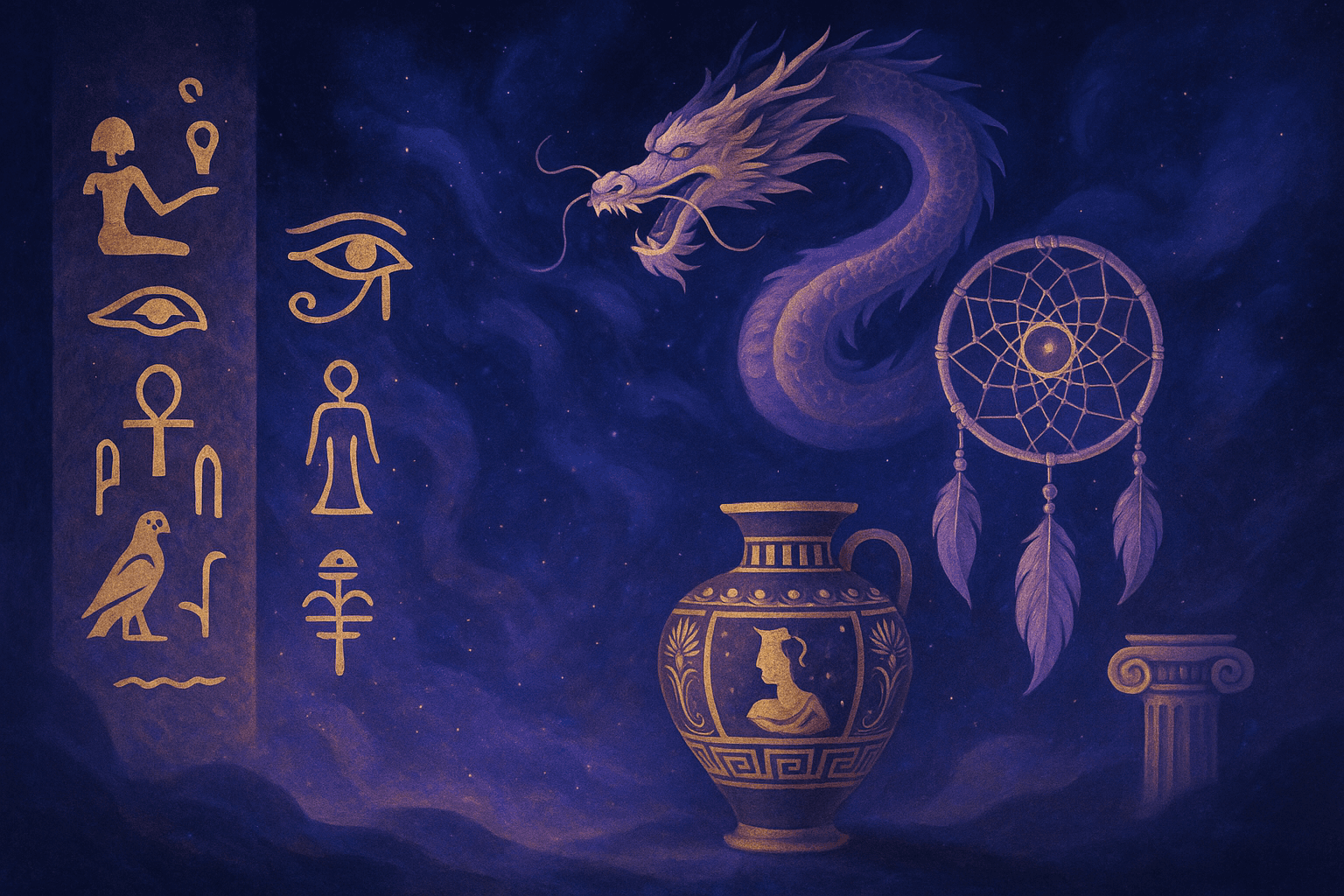
This reading connects to broader symbolic associations in Chinese cosmology. The dragon — which flies — is the supreme auspicious symbol, associated with imperial power, rain, abundance, and transformative force. Flying dreams carry some of that symbolic territory.
Context within the dream matters. Flying over water connects to prosperity or to significant travel. Flying over mountains signals the overcoming of major obstacles — the height of the obstacle corresponds to the scale of what is being surmounted. Flying freely with no particular destination is read as freedom itself, a relief from whatever circumstances have felt constraining.
The Chinese tradition does not generally read flying as spiritually ambiguous the way the Jungian framework does. It's positive. The only significant exception involves flying that feels frightening or out of control, which shifts the reading toward instability or disruption ahead.
Where the Traditions Converge
Five frameworks from different civilizations and different centuries, and the overlap is substantial. Controlled, comfortable flying reads as positive across all of them: freedom, spiritual elevation, transcendence of current difficulties, confidence, and in some traditions literal soul advancement. That consistency across unrelated interpretive systems is striking.
The fall from flight is where most traditions introduce caution. Ibn Sirin reads it as aspiration exceeding its proper limits. Jung reads it as the psyche correcting inflation. Even the Chinese tradition, which is the most uniformly optimistic about flying, acknowledges that frightening aerial experiences carry different meaning.
The emotional quality and direction of the flight is universally relevant. Flying toward something carries different weight than flying away from something. Rising feels different from hovering. What you see below you, and whether it feels like freedom or escape, shapes what the dream is saying.
No tradition reads flying as inherently ominous. That alone is notable — not every common dream type gets such consistent positive treatment.
Frequently Asked Questions
What does it mean to fly in a dream spiritually?
Across most spiritual traditions, flying in a dream indicates elevation — either spiritual ascent toward a higher state, freedom from constraints that have been limiting you, or the soul's movement through levels of consciousness beyond the ordinary. Islamic interpretation connects upward flight to nearness to God. Hindu and yogic traditions read it as the subtle body in motion. Shamanic traditions treat it as literal soul travel. The consistent thread is that flying represents movement to a higher register, whatever framework you use.
Is a flying dream a good sign?
Generally, yes. Flying is one of the more positive dream symbols across cultures and interpretive systems. Controlled, comfortable flying — where you can direct yourself and the experience is pleasant — is read as a positive sign almost universally. The main exception is flying that ends in a fall, or flying that feels chaotic and frightening, which most traditions read as a signal of aspiration or ambition that has exceeded what can be sustained.
What does it mean when you fly and then fall in a dream?
The combination of flight and falling has a fairly consistent reading: the ascent represents ambition, aspiration, or genuine progress, and the fall marks a limit or a warning about overreach. Ibn Sirin saw it as ambition meeting its boundaries. Jung understood it as the ego inflating beyond what the psyche could sustain — the classic Icarus pattern. If this combination recurs in your dreams, it may be worth examining whether there's an area of your life where your sense of what's possible has outrun what you've actually built.
Why do flying dreams feel so real and memorable?
The vestibular system — which tracks your body's position in space — becomes partially active during REM sleep without the grounding reference points of waking life. The brain generates a physical sensation of movement and constructs a narrative around it. That combination of physical sensation and narrative produces a dream that registers as vivid and memorable in a way that purely visual or conversational dreams often don't. Flying dreams involve your body in a way that makes them hard to dismiss.
Explore the full flying dream meaning in our dictionary — with specific Islamic, Jungian, Biblical, Hindu, and Chinese interpretations alongside modern Western analysis.
References
- Muhammad ibn Sirin, Tafsir al-Ahlam — Ibn Sirin on Wikipedia
- Carl G. Jung, Man and His Symbols (1964) — Carl Jung on Wikipedia
- Stanley Krippner, dream and parapsychology research — Google Scholar
- Burke, C. (2016). "Flying dreams and waking correlates", Dreaming — Google Scholar
- Sigmund Freud, The Interpretation of Dreams (1899) — Archive.org
- Duke of Zhou's dream dictionary — Wikipedia
- Swami Sivananda on Hindu dream symbolism — Wikipedia
- "Rapid eye movement sleep" — Wikipedia
- "Vestibular system" — Wikipedia