Carl Jung's Dream Theory: What He Actually Believed (And What Gets Misquoted)
Between 1913 and 1916, Carl Jung kept a dream journal unlike anything in the history of psychology. He was in the middle of what he later described as a "confrontation with the unconscious" — a years-long period of psychological crisis that followed his break with Freud. He painted the images he encountered in dreams and active imagination. He wrote dialogues with figures who appeared to him. The result was the Red Book, a massive illuminated manuscript he kept locked in a bank vault, showed to almost no one, and which was published only in 2009, nineteen years after his death.
This is worth saying plainly before anything else: Jung was not writing about dreams from a clinical remove. He was someone for whom the interior life was a place he had actually been, at significant personal cost. That shapes how his theory reads once you get into it.
His core disagreement with Freud is also worth naming immediately, because the two are often lumped together as if they said the same thing. They didn't.
Jung vs. Freud: The Specific Disagreement
Freud's model rests on concealment. In his framework, the dreaming mind takes a forbidden wish — usually erotic, often aggressive — and disguises it so thoroughly that you don't recognize it for what it is. The dream you remember (the "manifest content") is a coded version of the real material underneath (the "latent content"). Interpretation, for Freud, means breaking the code.
Jung thought this was wrong, and he said so clearly in Memories, Dreams, Reflections: "Dreams are not deliberate inventions. They are natural occurrences." He didn't believe the unconscious was trying to hide anything. He believed it communicated in symbols because symbols are its natural language — the way the unconscious actually thinks, not a cipher it uses to fool you.
The practical difference matters. For a Freudian interpreter, a snake in a dream has a relatively fixed meaning. It's a symbol of the phallus; work backward from there. For a Jungian, a snake is a starting point. What does the snake mean to you? What happened in the dream? What does the snake mean across myths, religions, folklore? All of that is material. The symbol opens outward rather than collapsing down to a single decoded meaning.
This is why Jungian interpretation requires more from the dreamer. You can't just hand the dream over to a therapist and get the answer. You have to do some of the work yourself.
The Collective Unconscious
Jung's most original — and most contested — contribution is the idea that the unconscious has layers. The personal unconscious contains what you'd expect: forgotten memories, repressed experiences, material from your own life that hasn't made it into conscious awareness. Below that, Jung proposed, is something he called the collective unconscious: a layer shared by all humans, containing inherited patterns he called archetypes.
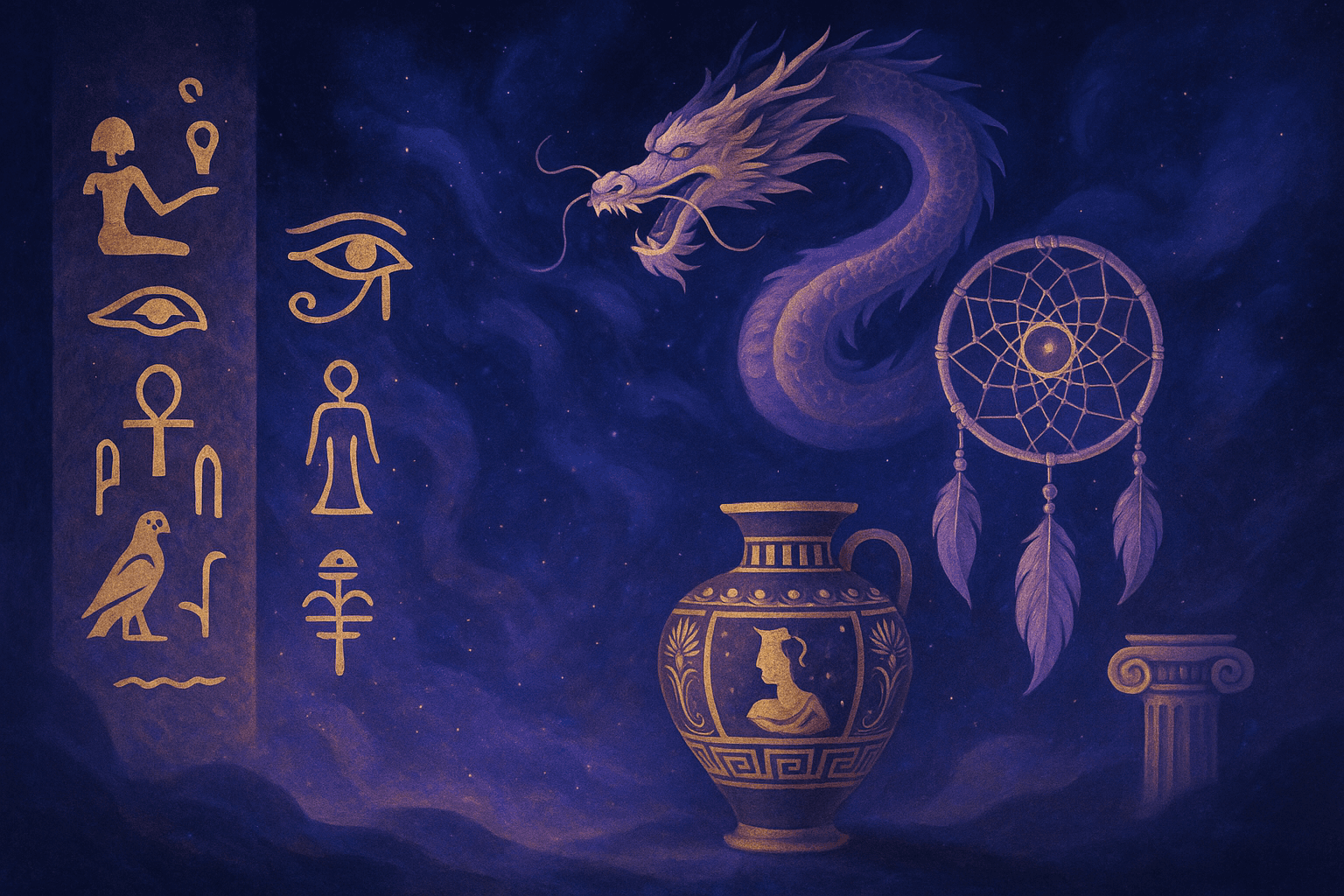
His evidence was cross-cultural symbol similarity. A snake as a symbol of transformation and danger appears in ancient Egyptian religion, in the Hindu tradition (the Kundalini serpent), in Greek mythology (the staff of Asclepius), and in Mesoamerican iconography. The mother figure — simultaneously nourishing and devouring — appears across traditions with no historical contact. Jung found the same patterns in his patients' dreams that he found in medieval alchemy texts, in Gnostic myths, in traditions from the other side of the world.
He argued in The Archetypes and the Collective Unconscious that these weren't transmitted culturally. They were inherited biologically — not specific memories or images, but patterns for experiencing reality. The archetype itself isn't a picture; it's a tendency to form certain kinds of pictures in response to certain kinds of experience.
This is where Jung's theory becomes genuinely hard to evaluate. It's a large claim about human biology, and the evidence he offered (symbol similarity across cultures) has other possible explanations, which we'll get to. But as a descriptive observation, the pattern he noticed is real enough: certain images recur in human dreaming across cultures and centuries in ways that are at least striking.
The Main Archetypes in Dreams
The Shadow
The Shadow is the part of yourself you've rejected — the traits that don't fit your self-image, the qualities you find intolerable in other people (often because they exist in you). In dreams, the Shadow typically appears as a threatening figure of the same sex. A dark stranger. Someone chasing you. A criminal. A version of yourself that does things you wouldn't do.
Jung was specific about this: the Shadow is not evil. It's disowned. The goal of dream work, in his view, isn't to defeat Shadow figures but to recognize them — to acknowledge that the qualities they embody belong to you, not just to some external threat. Running from the shadowy figure in a dream is, symbolically, running from yourself. Turning to face it is the work.
In Man and His Symbols, Jung wrote: "The shadow is a moral problem that challenges the whole ego-personality, for no one can become conscious of the shadow without considerable moral effort."
The Anima and Animus
A man's unconscious contains a feminine aspect Jung called the anima. A woman's contains a masculine aspect he called the animus. These appear in dreams as specific characters — for a man, often a mysterious or alluring woman; for a woman, often an authoritative or dangerous man.
The anima and animus represent inner qualities the dreamer hasn't integrated — feeling and relatedness in the case of anima, decisiveness and logos in the case of animus. When these figures appear in dreams, particularly when they're vivid or emotionally charged, Jung saw it as an opportunity to bring those qualities into conscious relationship rather than leaving them projected outward onto real people.
The Self
The Self is Jung's term for the archetype of wholeness — not the ego (the "I" that shows up in ordinary consciousness), but the totality of the psyche, conscious and unconscious together. It appears in dreams as circular symbols, as a figure of unusual authority or wisdom, sometimes as a divine or god-like presence. The mandala — a circular, symmetrical design appearing across Buddhist, Hindu, and other traditions — is the Self's most recognizable visual form.
Jung considered encounters with the Self in dreams to be significant markers of psychological development. He described them in Memories, Dreams, Reflections in terms that are almost religious: the Self as the organizing center of the psyche, pulling disparate aspects toward integration.
The Persona
The Persona gets less attention in dream interpretation, but it's relevant. The Persona is the social mask — the face you present to the world, built from roles and expectations. Dreams where you're naked in public, wearing someone else's clothes, or unable to locate the right costume often touch on Persona anxiety: the gap between performance and actuality.
What Jung Meant by "Compensation"
One of Jung's most useful ideas for practical dream work is compensation. He observed that dreams tend to correct the one-sidedness of waking consciousness. If you've spent your waking life being rigidly rational and dismissive of emotion, your dreams may flood with emotional content. If you've been arrogant about a decision, a dream might show you humiliated. If you've been too passive, a dream might show you acting with force.
He described this in The Archetypes and the Collective Unconscious as the unconscious maintaining psychic equilibrium — not punishing the dreamer, but pushing back toward balance.
For interpretation, this is genuinely useful as a question: what attitude or stance in my waking life is this dream pushing against? What am I overemphasizing, or ignoring? You don't need to accept Jung's full theoretical framework to find that question productive when you're sitting with a dream.
Working with Dreams the Jungian Way
Jung was skeptical of fixed dream dictionaries — books that tell you a house means family, water means the unconscious, flying means freedom. That kind of one-to-one translation was exactly what he thought missed the point. A symbol's meaning depends on the dreamer, the dream, and the moment.
The Jungian approach uses several techniques. Amplification is the main one: you start with a symbol from the dream and explore it in multiple directions — your personal associations, cultural and mythological parallels, what that symbol has meant in human history. If water appears in a dream, you explore what water means to you, what it does in the dream, and also what water has represented across traditions (chaos, the unconscious, transformation, birth, death). You're not looking for the right answer; you're expanding the symbol's resonance until something clicks.
Active imagination is another technique: engaging with dream figures in a waking state, essentially continuing the dream consciously. Jung practiced this extensively during his years of crisis. You sit quietly, invite the figure to appear in imagination, and have a dialogue. He was serious about this — not as metaphor, but as actual practice. Whether you find it useful probably depends on how comfortable you are with that kind of interior work.
He also emphasized that a single dream rarely tells you much. Dream series are more revealing. Patterns across many dreams show you what the unconscious is consistently working on. This means keeping a journal matters — not just recording individual dreams, but reading back through weeks or months to see what recurs.
The Criticism Worth Taking Seriously
Jung's theory of the collective unconscious is not scientifically established. The cross-cultural symbol similarities he cited are real patterns, but they have other explanations: common features of human experience (everyone has a mother, everyone has a body, everyone experiences death), shared evolutionary pressures on what feels threatening or sacred, and in many cases, more historical contact between traditions than Jung assumed.
The collective unconscious is an unfalsifiable hypothesis in the strict sense — there's no observation you could make that would definitively rule it out. That's a problem if you're looking for a scientific theory.
This doesn't make Jung's framework worthless for understanding your own dreams. His descriptions of the Shadow, the Persona, the compensation function, the associative method of interpretation — these can be useful regardless of whether the collective unconscious exists as a biological structure. But it's worth knowing, when you pick up a Jungian interpretation guide, that you're working with a psychological theory built partly on clinical observation and partly on speculation. Not a law. A lens.
Frequently Asked Questions
What is the difference between Freudian and Jungian dream interpretation?
Freud believed dreams disguise forbidden wishes — the dream-work censors the real (usually sexual) content and produces a symbolic disguise. Interpretation means decoding the disguise. Jung believed dreams communicate directly using symbols, and that those symbols expand rather than conceal. Freudian interpretation tends toward fixed meanings (the symbol points to one thing); Jungian interpretation is associative and personal (the symbol is a starting point for exploration). The practical result is that Freudian interpretation centers on what's being repressed, while Jungian interpretation centers on what the psyche is trying to integrate.
What is the Jungian collective unconscious?
The collective unconscious is Jung's term for a layer of the psyche he believed was shared by all humans — not personal memories, but inherited patterns called archetypes. These patterns, in his view, generate similar symbols across cultures: the great mother, the hero, the trickster, the shadow. His evidence was the appearance of similar symbols in dreams, myths, and religious traditions across cultures with no historical contact. The theory is influential but not scientifically confirmed.
How do I actually interpret a dream using Jung's method?
Jung's method centers on amplification: take a symbol from your dream and explore it in multiple directions — what does it mean to you personally, what has it meant in myths and traditions, what role does it play in the dream's narrative? You're not trying to decode the symbol to a single meaning; you're expanding your understanding of it until something feels genuinely resonant. Keeping a dream journal over time matters, because patterns across many dreams are more revealing than any single dream.
What does it mean if I dream about a threatening stranger?
In Jungian interpretation, a threatening figure of the same sex often represents the Shadow — the aspects of yourself that you've rejected or not acknowledged. The figure being threatening doesn't mean it's evil; it means it's carrying qualities you haven't integrated. Jung's suggestion would be to ask what qualities the figure embodies and whether those qualities exist somewhere in you. The work is recognition, not escape.
Explore Jungian interpretations alongside five other traditions for any dream symbol in our dream symbol dictionary — each symbol page includes analytical psychology interpretations alongside Islamic, Biblical, Hindu, Chinese, and Western readings.
References
- Carl G. Jung, Man and His Symbols (1964, Doubleday) — Carl Jung on Wikipedia
- Carl G. Jung, Memories, Dreams, Reflections (1962, Pantheon) — Archive.org
- Carl G. Jung, The Archetypes and the Collective Unconscious (1959, Princeton University Press) — Google Scholar
- Carl G. Jung, The Red Book (Liber Novus) (published 2009, W.W. Norton) — Wikipedia
- "Jungian archetypes" — Wikipedia
- "Shadow (psychology)" — Wikipedia
- "Collective unconscious" — Wikipedia